Somebody down the block gets real stone laid, and by the end of the month three neighbors want that look without the grout lines and the wobbling.
That is stamped concrete, and it is a good share of what we pour for homes from Creekbridge out to Spreckels. Patios, walkways, a stamped concrete driveway, pool decks, stamped walls and stamped concrete curbing along the beds.
What I will not do is stamp a slab that has gone past its window. Press a mat into concrete that has already tightened and you get shallow, blurry texture that no amount of stained stamped concrete will rescue. Our gray mornings buy us working time; a warm dry afternoon takes it back, so we time the pour around that.
Down the page: how the work goes, what moves the price, when this is the wrong call, and what people ring about most. Call (831) 539-2803 and we can walk the yard together.
Textured Concrete
Textured concrete is what we steer people toward when they want grip and depth without the grout lines a full pattern gives you: seamless skin mats, texture rollers and sometimes just a heavy broom, worked in while the slab is still open. The window is short. Once the bleed water goes off and the fog lifts, the surface flashes over and you end up with half a texture on one side of the pour, which is why we put more hands on a job like this than the square footage suggests. Leave too much stamped concrete release agent sitting in the low spots and the finish goes blotchy, so we wash and rinse it out before any sealer touches it. Vertical work uses the same skins, so stamped walls and stamped concrete curbing get textured off those mats too. Textured flatwork is a good chunk of what Salinas Concrete Company pours in a year, mostly patios and pool decks where people are barefoot. Size, truck access and how many texture changes you want move the price more than the color choice does.
Exposed Aggregate Concrete
Some jobs don't want a pattern at all. Exposed aggregate concrete skips the mat entirely: we pour, spray a surface retarder across the top, then come back the next morning and wash the cream off to uncover the stone underneath. Timing is the whole trick. Wash too early on a cool, foggy morning and you dig the rock right out of the slab. Wait too long on a hot afternoon and the paste has locked up, so now you're grinding. That call gets made on site, watching the slab instead of the clock, which is the part of the job Salinas Concrete Contractors earn their keep on.
Done right you get a surface that grips wet feet by a pool and hides leaf stain. We often frame it with a stamped concrete band so the two textures read as one design.
Stamped Concrete Driveway
A driveway carries a car, sometimes a work truck with a trailer behind it, so a stamped concrete driveway gets built heavier than a patio. Five inches over four inches of compacted Class 2 base, number four rebar on eighteen inch centers, and control joints cut inside the first day so the slab cracks where we put the line instead of straight down the middle. We tuck those saw cuts into the pattern grout lines where the layout allows.
Stamp too deep and the low spots hold grit, and every wheel that turns on the apron grinds it in like sandpaper.
Sealer gets renewed every two or three years here, sooner on the west facing side. Stamped concrete edging along the lawn keeps mower tires off a green edge, which is a repair nobody enjoys.
Ashlar Slate Concrete Stamp
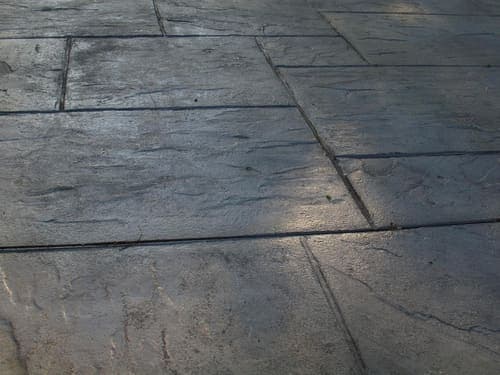
The ashlar slate concrete stamp is the pattern I set more than any other, and it forgives a lot. Irregular rectangles, a shallow slate texture, joints about three eighths deep. From six feet away it reads as cut stone and doesn't shout.
Layout is where these go sideways. The mats repeat, so if the first row lands off a crooked line, that seam marches straight across your patio and you'll see it every morning over coffee. We snap lines off the house, set row one true, then hand chisel the joints where mats overlap so the repeat disappears.
Timing beats muscle. Our afternoon wind can stiffen a slab an hour early, and a late stamp leaves faint texture that wears flat under patio chairs. A soldier course of stamped concrete edging frames the field and keeps the pattern honest at the borders. That hand work is slow, and it's part of what a big pour costs in labor.
Stamped Concrete Colors
Picking stamped concrete colors is where people freeze up, fan deck in hand, squinting on the driveway. Here's the shortcut: hold the sample outside, against your stucco and your roof, around two in the afternoon when the fog has burned off. Wet concrete reads richer than cured concrete, so what you choose will finish a shade or two lighter than it looks the day we pour.
Painted stamped concrete is the one I'd steer you away from. Paint sits on top of the slab instead of in it, and it starts flaking along tire tracks and edges. Stamped concrete no color is a legitimate choice too, plain slab with the texture doing the work.
Border color is worth a thought as well. We'll often run stamped concrete edging or curbing a step darker to frame the field, and as Salinas Concrete Contractors we'll pour you a sample board before anything is permanent.
Stamped Concrete Patterns And Colors
Pick stamped concrete patterns and colors together, outside, in daylight, because a chip you approve under a garage bulb turns into something else at two in the afternoon. Patterns are where people agonize, but what really decides how a slab looks is how many mats we run. Four mats across a big pour gives you a repeat you can spot from the porch, the same three bars of a song on a loop. We work in running bond brick, cobble, wood plank and texture skins, rotating them so the joints never settle into a grid.
Borders do more for the look than the field does. A soldier course or a clean stamped concrete edging frames a patio, and we can carry the same texture up steps, low walls and stamped concrete curbing so it reads as one piece.
Painted stamped concrete peels. Integral color doesn't.
Stamped Concrete Patio Colors
Patios get walked on barefoot, and that changes the color conversation entirely. A charcoal slab in August, once the fog burns off by ten and the valley settles into the nineties, will cook your feet. So for stamped concrete patio colors I usually steer you toward a buff, tan or light sandstone base and let the antiquing carry the depth. Then match it to what's already there: the stucco, the roof tile, the fence.
Two things I'll talk you out of. Painted stamped concrete, because paint sits on top and peels within a couple of summers of sprinkler overspray. And stamped concrete no color, which goes flat and dull against a green lawn.
We're Salinas Concrete Contractors before we're colorists, so we set sample boards on your ground in afternoon light. Stamped concrete edging in a deeper tone frames the whole thing.
Color Hardener For Stamped Concrete
Color hardener is the powder we broadcast over the wet slab and float in before a stamp ever touches it. Two shakes, not one. The first pass takes the bulk of it, the second fills the holidays, and every crew running a job for Salinas Concrete Contractors works it in that order because that's what keeps the color even.
It does more than tint. Hardener densifies the top layer, so the surface shrugs off dog nails, patio chairs and the grit that blows in off the valley all summer.
Skimp on coverage and you'll know within a year. Pale patches, and the moment someone chips an edge, that gray core underneath shows through. Same reason painted stamped concrete peels: the color is sitting on the slab instead of in it.
On hot afternoons we shade the pour so it doesn't flash off before we've floated.
Stained Stamped Concrete
Staining is the move when the slab is already down. Maybe it went in as stamped concrete no color years back, maybe the last owner went at it with deck paint. Acid stain reacts with the lime in the cement, so it soaks in and mottles instead of sitting on top like a coat of makeup. That mottling is the whole point, no two square feet match.
Painted stamped concrete peels. Stain doesn't, because there's nothing to peel.
The work: degrease, rinse, mask, spray, then neutralize the residue and rinse again. Skip that neutralizing step and your sealer lifts in sheets by the second foggy winter. Fresh pours wait about 28 days before we touch them.
Size, how many colors, and how much old coating we grind off are what move the number on stained stamped concrete. Salinas Concrete Contractors handles the strip-and-stain jobs too, not just new pours.
Stamped Concrete Release Agent
Release agent is the powder or liquid we throw down right before the mats go on, and it does two jobs at once. It keeps the stamp from sticking and tearing the surface, and the powder version drops a second color into the grout lines and low spots, which is what gives stamped concrete patterns and colors that aged, uneven look instead of a flat rubber-stamp finish. Skip it, or go light with it, and you get lifted cream, smeared texture, and a slab that reads as fake from the sidewalk.
Then it has to come back off. We wash usually a day or two later, longer when the marine layer rolls in off the valley and the slab stays cold and green.
Leave residue under sealer and it turns cloudy. That is why the crew at Salinas Concrete Contractors rinses twice and checks in daylight.
Gray Stamped Concrete
Gray is the one people talk themselves out of, then end up loving. A plain mix with no pigment in it, what we call stamped concrete no color, still takes a pattern cleanly, and the release agent drops enough shadow into the joints that the texture reads from the sidewalk. It sits right next to stucco, redwood fencing and the fog that hangs over town half the mornings in June.
Two ways it goes sideways. Blotchy gray, which comes from a slab that got sprinkled with water to make troweling easier, and painted stamped concrete, which peels in sheets the first winter water sneaks under the film.
Most of the gray work we do as Salinas Concrete Contractors gets a penetrating sealer instead, redone every two to three years, and clean stamped concrete edging to frame it.
Dark Gray Stamped Concrete
Dark gray is the one people ask for after they've seen a charcoal patio somewhere and can't stop thinking about it. It isn't one color out of a bag. We build the depth by working a slate or charcoal hardener into the surface, then washing back a black release so the grout lines and low spots hold the dark while the high spots come up lighter. Pour it flat in a single tone and you've got a nice smooth parking lot.
Two honest warnings. Efflorescence, that chalky white bloom, shows on dark gray stamped concrete far more than it does on tan, so plan on a reseal every two or three years. And once the fog burns off in July, a dark slab gets hot underfoot. That's physics, not workmanship, and Salinas Concrete Contractors would rather you hear it now than in August.
What the job involves
Here's the order of it. We break out whatever's there, shape the subgrade, and compact four inches of Class 2 base, because a pretty slab sitting on soft ground is a jigsaw puzzle waiting to happen. Then forms, rebar or mesh, and the pour.
The stamping window is the whole ballgame. Press the mats too early and you get mush, too late and you get a faint impression that looks like textured concrete from a distance and nothing up close. On a warm afternoon here, that window can be twenty minutes wide, which is why we bring enough hands to stamp the whole pad at once.
Control joints get cut within a day, the stamped concrete edging gets detailed by hand, and we let the slab cure three to four weeks before sealing. Keep vehicles off for the first seven days.
What it costs
What moves the number on a stamped job isn't the stamp. It's everything under it and around it. Ready mix lands here at roughly $100 to $200 a cubic yard delivered, pour labor sits around $2.50 a square foot before anyone lays a mat down, and stripping forms, cleaning up and stacking adds another $0.30 to $0.60 on top of that.
From there it's choices. A plain gray stamped concrete patio, one pattern, one release, is the lean end of the sheet. Add a second color, a soldier border, stamped concrete edging cut tight around a curve, or stained stamped concrete once it's cured, and you're adding hours. Hours are the whole game.
Call me at (831) 539-2803 with your square footage and I'll give you a straight figure. That's how we price every job at Salinas Concrete Contractors, off your actual slab and your actual pattern.
When stamped concrete is the wrong fix
Stamped concrete is the wrong answer on a slab that's already moving. If your patio has a lip at a joint you can feel through a shoe, or a crack that keeps opening, a stamped overlay just copies that crack straight up through the pattern within a season or two and you've paid for the pretty part twice. That's concrete repair first, or a tear out and fresh concrete flatwork. Same story with a concrete driveway sitting on a base that's given up. Where the slab is sound and only looks tired, resurfacing does the job honestly.
And a damp, shaded side yard doesn't need decorative concrete finishes at all. A broom texture or exposed aggregate concrete grips better underfoot and takes less labor to place, which is the cheaper end of the conversation anyway.
Why choose us for this
You want the stamped concrete poured once, finished right, and off your mind until the kids are old enough to park on it. Not a job you watch from the kitchen window while half the crew slips off to a second pour across town.
So the number I give you is the number on the invoice unless you change the plan, and your slab gets stamped, rinsed, cured and sealed before we start anybody else's patio. Colored release powder is the messy part of this work. It washes off gray, it stains fence boards and rose beds, and we catch that runoff and haul it out rather than letting it find the storm drain.
A light bid is usually light on hand work: tooled edges, joints cut where the slab wants to crack anyway, and a cure given its full time instead of a quick hose down. Having me come look and price it puts you under no obligation at all.
Frequently asked questions
How long before I can walk on my stamped concrete?
Foot traffic at 24 to 48 hours. Keep the furniture off it for a week, and no vehicles on a new stamped concrete driveway for seven to ten days. Morning fog holds moisture in a fresh slab and slows the cure, so we'd rather hold you off an extra day than watch you press tire marks into your own patio.
Do I need to reseal it or resurface it?
Two different jobs. Sealer is maintenance on concrete that's still sound, and it's what keeps stamped concrete colors from going chalky under the summer sun. Resurfacing is for a slab that's spalling or worn flat, where we bond a new wearing layer over the old one and stamp that.
What happens when I call about a patio?
We come out, measure, and walk the layout with you. Then the stamp mats and color samples go down on the ground so you can see gray stamped concrete next to blue stone stamped concrete in daylight, which is the only place they tell the truth. The number is (831) 539-2803.
Contact Salinas Concrete Company now
If you want a concrete company in Salinas that stamps slabs week in and week out, call us at (831) 539-2803. Somebody is at the phone from nine to five, Monday through Friday, and a message left outside those hours gets a call back.
When I come out, I bring sample boards, so you can hold an ashlar slate concrete stamp up against your siding and your fence instead of squinting at photos on a phone. We walk the area, talk through stamped concrete patterns and colors, and figure out whether stamped work, textured concrete or exposed aggregate concrete suits how hard that space gets used.
One thing to know before pour day: the powdered release agent travels, especially with the afternoon wind. We sheet the cars, the fence line and the planting beds, then wash the residue off later that week.