The top step wobbles, the edges are crumbling, and somebody's grandmother is holding that railing with both hands.
Nothing ages a house faster than concrete steps you have to warn guests about. We form and pour steps, landings and concrete stairs all over Salinas, from three risers off a front porch on Central Avenue to a full concrete landing for deck stairs out back. Sometimes precast concrete steps are the quicker call instead, but the footing question underneath is the same either way.
What we will not do is set fresh treads on a footing that has already dropped. It settles again the first wet winter, and it takes the new work with it, so we dig, we look, and we tell you what is really holding your stairs up.
Further down: how the job goes, what moves the price, when steps are the wrong answer, and the questions that come up most. Ring (831) 539-2803 and we will come look.
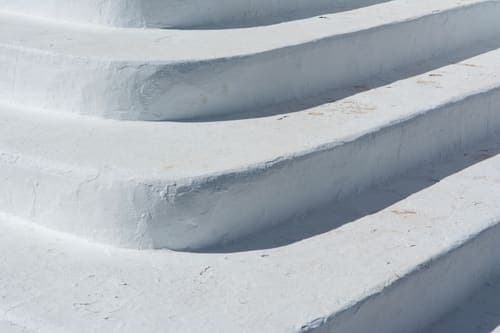
Precast Concrete Steps
Precast steps arrive as a finished unit on a truck and get set on a prepared pad. They are quick, they are cheaper than forming on site, and for a straight run off a back door they are often the sensible answer.
Where they stop making sense is anywhere the geometry is not standard. A precast unit comes in fixed rises and fixed widths, so if your porch sits at an odd height, you end up with one short riser at the top or the bottom, and an uneven riser is the one people catch a toe on. Code wants your risers within about three eighths of an inch of each other for exactly that reason.
They also need a proper pad underneath. Setting a two-ton precast unit straight onto valley clay is how it ends up leaning toward the flowerbed inside a couple of wet winters.
Cinder Block Steps
Block-and-fill is the middle option: we lay the structure in cinder block, fill the cores with concrete and rebar, then face and cap the whole thing so it reads as poured. It is stronger than it sounds and it lets us hit any rise and run your doorway actually needs.
It is also the right call when the steps are tall enough to want a landing partway up, or when you are tying into an existing porch slab and matching a height nobody planned for.
The part that decides whether it lasts is the footing. We dig below the loose stuff to firm ground, tie the block into it, and let the fill cure before anything gets faced. Steps built on a shallow footing pull away from the house, and once that gap opens up, water gets in and finishes the job.
What the job involves
We start at the door and work down. The finished floor height, the total rise, and the run available decide everything else, so that measurement gets taken before anybody talks about price. From there it's excavation to firm ground, a footing tied with rebar, then either forms and a pour or block set and filled.
We tool the nosings, broom the treads so they are not a skating rink the first foggy morning, and cut a joint where the steps meet the walkway so the two can move independently instead of cracking each other.
Most residential runs are two to three days on site: a day for excavation and footing, a day to form and pour, and a return visit to strip forms and finish. Light foot traffic after about a day, and keep anything heavy off for a week.
What it costs
Straight answer first: steps cost more per square foot than flatwork, because you are paying for forming and footing rather than for concrete. Ready mix runs somewhere between $100 and $200 a cubic yard depending on the mix and the load size, labor is roughly $45 an hour on the crew, and the forming is where the hours go.
A short two-riser stoop off a back door is a small job. A wide front entry with a landing, a return wall and a handrail core is several times that, and precast is usually cheaper than either if the geometry suits it. Demolition of the old steps and hauling the rubble adds to it, and on a tight lot where everything moves by wheelbarrow, so does access.
Call us at (831) 539-2803 and we'll measure the rise and give you a real number. Anyone pricing steps off a photo is guessing at the footing.
When concrete steps are the wrong fix
Sometimes concrete steps are the wrong fix, and I would rather say that before we set a single form. If your treads keep dropping because the slope behind them is creeping downhill, new concrete stairs will ride that same soil right back down, and what you actually need first is a concrete retaining wall to hold the bank. If the risers have pulled away from the house, the trouble usually starts at the concrete foundation, and pouring fresh steps over it just hides the crack for a season or two. A single step up to a side door often wants a small pad tied into your existing concrete patio, or a short run of concrete paving instead. And if your wood stringers are still sound, you may only need a concrete landing for deck stairs at the base, not full concrete removal.
Why choose us for this
You've got concrete steps that are cracked, leaning, or sitting a half inch proud on one riser, so the same person catches the same toe every time they come up. What you want isn't craftsmanship. It's to hire somebody once, not supervise them, and not think about the front of your house again for years.
The number I give you is the number on the invoice unless you change what you asked for. Once your footing is dug, your stairs get finished before anybody else's gets started, and the broken concrete goes out on our truck rather than sitting on your lawn until spring.
I'd sooner lose the job than pour a set of steps and a concrete landing for stairs over ground I don't trust, because these are the one thing on your property people fall down. Coming out to look and price it puts you under no obligation to book.
Frequently asked questions
How long do concrete steps take?
Two to three days on site for most residential runs, spread over about a week. Excavation and footing on day one, forms and pour on day two, then we come back to strip the forms and finish. You can walk on them carefully after about twenty-four hours and normally after a week.
Can you match my existing porch or walkway?
Usually close, rarely exact. New concrete cures lighter than old concrete and then darkens for months, so a fresh pour beside a twenty-year-old slab will look different for a season whatever we do. If matching matters, staining or a broom finish across both is the honest way to get there.
Do my steps need a handrail?
Once you are above a certain number of risers, yes, and the inspector will look for it. We form and set the core so a rail can be anchored properly rather than drilled in afterwards as an afterthought.
Why are my steps pulling away from the house?
Because the footing is shallower than the frost and moisture line, or because they were poured against the house rather than tied to it. Valley clay swells when the winter rain comes and shrinks again by August, and anything sitting on it moves. That is fixable, but it is a rebuild rather than a patch.
How do we get started?
Call me at (831) 539-2803 or use the form on this page. I come out, measure the rise from your door, look at what is under the old steps, and put a written number in your hand. It costs nothing and it books nothing.
Contact Salinas Concrete Company now
Call the Salinas concrete company that still takes the small stuff seriously: three risers off a back door counts, and so does a full run of concrete stairs down a sloped lot. The number is (831) 539-2803, nine to five Monday through Friday, and a message left after hours gets a call back.
A few things help when we talk. How many steps you have now, whether they are sinking, spalling or just built too steep to feel safe in the rain, and what sits at the top. A concrete landing for deck stairs gets tied to the framing differently than one poured against a house wall, so tell me which you have.
Then I come measure the total rise, check where water runs, and say plainly whether poured concrete steps or precast is the better call.