A crack you can catch a toe on, or a step corner that came away in your hand.
Most concrete repair calls start the same way. You walked past it for two years, then somebody's mother-in-law tripped on it, and now it's urgent. Fair enough. We patch, grind, resurface and seal cracks in concrete for houses and small businesses all over town, from Old Town storefront walks to driveways out past Boronda Road.
What we won't do is smear patch material over a crack that has crumbling edges under it. That lets go within a season and takes a chunk of your slab with it. We cut down to solid material first, every time, whether it's a flaking porch, a sunken walkway, or concrete driveway repair after a sprinkler line washed the base out from under one corner.
Keep going for how the work is done, what moves the number, and when repair isn't the right answer. Or call (831) 539-2803 and we'll come put eyes on it.
Cement Crack Repair
Hairline or hungry? That's the first thing I look at. Anything under about an eighth of an inch takes a low viscosity resin poured in and left to wick down. Wider than that and we chase it open with a crack chaser blade, vacuum the dust out, and pack it properly. Epoxy concrete repair holds beautifully when the slab has stopped moving. If it's still shifting with our valley clay after a wet February, we use a flexible polyurethane instead, or you'll see that line again by August.
A crack in basement floor concrete usually means water found a route. Deal with the water or the crack filling is just a bandage.
Most cement crack repair on walkways and steps takes an hour or two per crack, cured overnight. Our concrete contractors company grinds first on every concrete sidewalk repair and concrete step repair, because caulk over dust peels off in a season.
Concrete Crack Repair
Not every crack is trouble, but every crack is telling you something. Hairline shrinkage lines from the slab's first summer are cosmetic. A crack you can catch a fingernail in, one side sitting proud of the other, or one that got wider over a wet January in the valley, that's movement. Fill it without asking why it moved and you're putting a bandage on a broken leg.
So we read it first: width, offset, whether it's still opening. A static crack in a slab or a crack in basement floor gets chased out, cleaned of dust and filled, and epoxy concrete repair welds it back solid when nothing's shifting. Anything with lift or subgrade washout gets cut and replaced instead, which is what our concrete contractors company does with most sidewalk panels heaved by roots.
Seal Cracks In Concrete
Sealing is the step that keeps water back out of a crack you already fixed, and it's the one people skip. We rout the crack into a clean channel, blow it dry, drop backer rod in where it's deep, then fill it with a self-leveling polyurethane that stays flexible when the slab shifts in the January rain and again when it bakes through a dry August. Epoxy concrete repair has its place in a hairline that isn't moving. Push it into a working joint and it tears open right beside your bead.
Two things wreck a seal: dust and damp. Caulk over a wet slab peels off like a sticker.
When our concrete contractors company handles crack filling on a garage floor or a crack in basement floor, we keep traffic off it a full day so the seal cures instead of smearing.
Crack In Basement Floor
Basements are rarer here than in most of the country, but between older places in Old Town, wine cellars, and the sunken slabs under some of the commercial buildings, we see enough of them.
Most cracks in a basement or below-grade floor are shrinkage, and they appeared in the first year. Concrete gives up water as it cures, shrinks, and relieves the stress somewhere. Those are cosmetic. Route them out, fill with a flexible sealant, and forget about them.
The ones worth worrying about are the ones with water coming through, the ones wider at one end than the other, and the ones where one side sits higher than the other. Those mean the ground under the slab has moved, and filling them treats the symptom.
Where water is coming up through a floor crack, the fix is usually drainage outside the building rather than sealant inside it. We will tell you that even though the sealant is the easier sell.
Crack Filling
Filling cracks is mostly prep, and prep is where the shortcuts live. I open the crack with a saw or a grinding wheel, blow and vacuum it out, and pack the deep ones with backer rod so the sealant sits at a working depth instead of disappearing into the void underneath. Cracks that move through the day get a flexible polyurethane. Static ones get a rigid epoxy or a sand-filled mortar that can be feathered flush. The thing I flat refuse to do is smear filler over a crack with crumbling edges under it, because that lets go inside a season and takes a chunk of slab with it.
Most jobs are a morning. Total footage, how deep the crack runs, whether the edges are still sound, and how far we're hauling gear from the street are what shift the number.
Concrete Patching
Concrete patching handles the small damage that ruins an otherwise decent slab: a broken step nose, a gouge where somebody dropped an engine block, a pop-out in the walk you keep catching your toe on. A patch has to have edges to hold onto. We saw cut the damage square, chip back to sound concrete, and never feather the repair out to nothing, because a feathered lip ends up paper thin and flakes off the first real wet stretch of the year. Then a bonding slurry or an epoxy mortar, depending on depth and whether anything parks on it. Smearing fresh mix over a crumbling edge lets go inside a season and takes a chunk of slab with it, so we don't.
Most patches take a morning. Depth drives the cost of patching concrete slab damage more than square footage does.
Same method on a step, a garage floor or concrete sidewalk repair, just a smaller footprint.
Concrete Driveway Repair
Driveways here fail from the bottom up. Salinas Valley clay swells with the January rain and shrinks tight by August, and a slab poured over loose fill rides that seesaw until a panel cracks or drops a half inch at the control joint. Park a work truck on it, or let an ag rig swing wide into the apron, and cracked concrete goes from ugly to a genuine trip hazard in one season.
So our concrete driveway repair starts under the slab, not on top of it. We saw out the failed panels, recompact and regrade the base, then pour back at matching thickness with rebar where vehicles turn.
One thing our concrete contractors company won't do is patch a panel that's still moving. Stay off fresh panels for a week, cars only after that.
Fill Cracks In Driveway
Width decides the method. Anything under a quarter inch gets opened up with a crack chaser blade and filled with a self-leveling polyurethane, and most driveways are done in an afternoon. Wider than that, we set backer rod first so the sealant has something to sit on instead of sinking out of sight and tearing at the edges once the January rain shows up.
The step people skip is the cleanout. Fill a joint packed with August dust and dead weeds and the sealant bonds to nothing, so it peels back like an old bumper sticker by the second foggy spring.
Crack filling buys real years on a slab that's otherwise solid. If the concrete rocks under your foot, that's a bigger fix, and our concrete contractors company will say so before touching a tube of sealant.
Recover Concrete Driveway
A recover keeps the concrete driveway you already own and gives it a fresh wearing surface, which is the concrete driveway repair that makes sense when the slab is sound but the top is worn out. We open the old surface with a shot blaster, degrease the oil shadows where the truck sits, prime the whole thing, then trowel down a polymer modified overlay about a quarter to a half inch thick. Foot traffic at 24 to 48 hours, cars after roughly a week.
An overlay copies whatever is under it. If the slab rocks when you drive on, or the apron has dropped an inch at the sidewalk, that movement prints straight through by the next rainy season. When I see that, I say so and we talk replacement instead.
Square footage, gate access, how much spalling concrete has to come off and how greasy the parking spot is all move the price. Foggy mornings keep the surface damp, so recover work here tends to start after lunch.
Concrete Driveway Crack Repair
A crack in a driveway is a hinge. Once the two sides start moving independently, water gets under the slab, the Salinas Valley clay swells through the winter rains and shrinks back in the August heat, and by spring you've got a lip you can catch a toe on.
So we don't just squeeze caulk in the gap and call it a day. We chase the crack out with a saw or a grinder to get clean, sound edges, blow it out, then fill it with a polyurethane sealant that flexes or an epoxy where the slab needs to act like one piece again. Epoxy concrete repair is strong but rigid, so we choose based on whether that crack is still moving.
Most driveways at our concrete contractors company take a morning, and you're parking on it the next day.
Spalling Concrete
Spalling concrete is the top skin of a slab flaking away in dinner-plate patches until the stone underneath is showing through. Around here it's almost never cold weather doing it. It's the salt air off the bay working on a slab that got troweled while bleed water was still sitting on the surface, or steel set an inch too shallow that has started to rust. Rust never sleeps, and rust swells, and the concrete above it loses that argument every time.
Catch it early and a bonded polymer-modified overlay, laid over a saw-cut and chipped-back edge, holds up well. Wait until a boot heel crumbles the surface and it isn't concrete repair anymore, it's a pour.
I sound the whole area with a hammer before quoting any concrete spalling repair, because the hollow part is always wider than the ugly part. Depth, square footage and the state of the steel below are what move the number.
Stamped Concrete Sealing
That patio you paid good money to have stamped like slate is only as good as the film sitting on top of it. In this valley I reseal stamped work every two to three years, sooner on a south facing slab that bakes all summer and then sits under fog half the morning. Bad stamped concrete sealing is easy to spot: white blush from sealing a slab that was still damp underneath, black smears where hot tires pulled the film right off the driveway, or a finish so glassy it turns into a slide the first wet day.
So our concrete contractors company strips what's failing, handles any concrete repair or crack filling in the pattern first, then rolls two thin coats of solvent acrylic with grit mixed in. Stay off it a day, keep the cars off for three.
What the job involves
Every repair I look at starts the same way, with me on my knees jabbing a screwdriver into the damage. If the tip sinks, the concrete underneath is punky and no patch is going to save it. If it rings hard, we're in business.
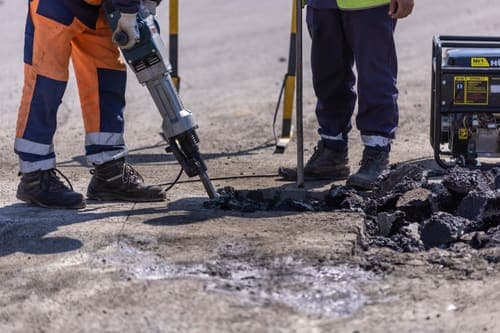
From there the work is saw cutting back to sound material with square edges, never feathering a patch out to nothing, because a thin edge breaks the first time a truck rolls over it. We clean it, bond it, and on structural work our concrete contractors company uses an epoxy concrete repair mortar that grips better than the slab it's fixing. Concrete step repair and concrete sidewalk repair need forms built on site, so those run longer.
Then you wait. Foot traffic the next day, vehicles after a week, full strength around 28 days. Salinas fog actually helps that cure.
What it costs
What does it run? Depends on what's under the crack, and that's not me dodging.
Straight crack filling on a driveway is a half day of work and the cheapest thing we do. Ready mix here runs about $100 to $200 a cubic yard delivered, and labor sits around $45 an hour, or roughly $2.50 a square foot on flatwork, plus another $0.30 to $0.60 a square foot for pulling forms, cleaning up and hauling the broken pieces out of your yard. A concrete slab repair where the base has washed out costs more than the patch, because we're fixing the reason and not the symptom. Concrete step repair is the same story.
Call us at (831) 539-2803 and we'll come look. What our concrete contractors company won't do is price cracked concrete off a photo, since the photo never shows the subgrade.
When concrete repair is the wrong fix
Sometimes concrete repair is the wrong call, and I would rather say so standing on the slab than take your money for it. If a section rocks underfoot and has dropped at one corner, the ground beneath it moved, and patching concrete slab edges over that just gives the same crack a fresh coat of paint. Break it out and pour new concrete flatwork over a base that holds.
Spalling concrete across most of a slab is the same story. Spot fixes leave you a checkerboard of gray shades that never blend, so resurfacing the whole concrete driveway is the better buy.
And if it was stamped, no patch material on earth matches decorative concrete finishes after years of sun on them. Replacing the panel beats staring at the scar. There is a point where new concrete costs you less than the third repair.
Why choose us for this
You've been walking past that cracked concrete for months, and what you want isn't concrete repair as a pastime. You want to hire one outfit, not supervise it, and not think about that slab again for years.
So your concrete slab repair gets finished before anyone else's driveway gets started. Skimming patch mix over a crack with a soft, crumbling edge underneath isn't repair, it's makeup, and it lets go inside a season and takes a piece of the slab with it. Same story on a concrete step repair where the nose is already flaking.
Saw-cutting throws gray slurry that will stain stucco, pavers and your neighbor's fence if nobody wets and covers them first, so that happens before the blade comes out.
Depth, access and how far the spalling has traveled move the number far more than the square footage does. Having me out to look obligates you to nothing.
Frequently asked questions
Should I repair this or just tear it out and replace it?
Repair, if the slab is still sitting flat and sound underneath. Cracked concrete under about a quarter inch with no rocking edges takes a routed and filled joint. Once a driveway shows spider webbing across the whole panel or the subgrade has washed out, concrete slab repair is just buying you a season.
How long before I can drive on it again?
Most cement crack repair work is walkable in a few hours and takes a car the next morning. Epoxy concrete repair on steps or a spalled edge wants roughly 24 hours before weight, longer if we get one of those damp gray Salinas mornings that never burns off.
How do we get started?
Call our concrete contractors company at (831) 539-2803 and we will come look at it.
Contact Salinas Concrete Company now
If you want a Salinas concrete company that will chase a crack back to whatever shifted under it, ring (831) 539-2803 and we'll pick a morning that suits you to walk the slab together.
What I'm looking at is depth and edges. Cracks in driveway slabs wide enough to swallow a dime are a different job from the hairline ones, and spalling concrete around a downspout usually means the top surface is giving up rather than the slab itself. Size, whether a truck can reach the pour, how deep the damage runs and the condition it's been left in are what shape the work.
I don't feather material over a crumbling edge, either. That lets go within a season and takes a fist-sized piece of good concrete with it.
And if it turns out you need stamped concrete sealing instead of concrete patching, I'll say so.