You've started steering around the ruts instead of looking at them. That's usually a year before anyone picks up the phone.
Concrete paving is most of what we pour: driveways, aprons, walkways and shop slabs, here in town and south through Chualar and Gonzales. We handle paver installation alongside it for folks who want a joint pattern instead of one big gray sheet, and there are yards where concrete paving stones beat a slab outright, since you can lift a section and reset it rather than sawing out half a drive.
One thing I refuse to do is pour driveway paving over a base nobody packed properly. It looks perfect the day the trucks pull off, then it splits right along your tire tracks by the second dry season, and no sealer on earth walks that back. Plenty of paving companies will skip that step because you can't see it.
Further down is how we build it, when a slab is the wrong answer, what pushes the number up or down, and the questions people bring up before booking. Or ring me at (831) 539-2803 and I will come take a look.
Paving Sealing
Sealing is the cheap thing that buys you years, and it is the one most people skip until the surface has already started to go.
On poured concrete a penetrating sealer soaks in and repels water and oil without changing how the surface looks. A film-forming sealer sits on top, darkens the concrete, and gives you that wet look people either love or hate. Either way it slows the freeze and salt damage, keeps oil from staining right through, and stops the surface dusting.
On pavers, sealing does something extra: it stabilises the joint sand, which is what actually holds the field together. A sealed paver drive sheds weeds and keeps ants out of the joints.
Timing matters. New concrete wants about a month before it takes sealer, and around here we want a genuinely dry stretch, which in a Salinas winter can mean waiting. Most driveways want resealing every two to three years.
What the job involves
Grade and base first, always. We strip out the old surface and the soft material under it, cut the subgrade to depth, and compact class 2 base in lifts rather than dumping it all at once and rolling the top.
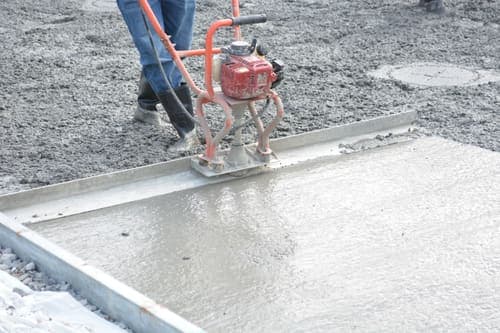
For poured concrete: forms, steel, pour, screed, float, joint and cure. For pavers: base, bedding sand, lay the field, cut the edges, set the restraint, then compact and sweep in the joint sand.
We stage a driveway so you are not fully without access where the layout allows, and where it does not, we tell you which days you are parking on the street rather than letting you find out.
A residential driveway is two to three days for either method. Concrete wants a week before a car sits on it and a month before you seal it. Pavers you can drive on as soon as the joints are compacted, which is the practical argument for them.
What it costs
Straight answer first: poured concrete is cheaper per square foot than pavers, usually by a good margin, and pavers generally last longer and repair better. Ready mix runs $100 to $200 a cubic yard, labor about $45 an hour, and the base work is a real line item rather than a rounding error.
What moves a driveway price is square footage, slab thickness, how much old surface has to come out, and access for the truck. Going from four inches to six with rebar because a work truck lives on it adds meaningfully, and it is usually worth it. A driveway approach that touches the city right of way brings permit and standards into it.
Pavers price on the unit you choose as much as the labor, and the spread between a basic gray holland stone and a tinted, tumbled paver is wide.
Call us at (831) 539-2803 and we'll measure and price both, so you can see the difference rather than take my word for it.
When concrete paving is the wrong fix
Sometimes concrete paving is the wrong fix, and you ought to hear that before anybody sets a form board. If the slab is basically sound and just broken at one corner, tearing out the whole thing is money burned; concrete repair on that section holds fine. If the bank behind your drive is creeping toward the pour, a fresh slab will crack along the same line by the end of the rains, and what you need first is a concrete retaining wall to hold that dirt back. Delivery trucks on a yard call for commercial concrete, thicker and reinforced, not a residential driveway paving mix. Want a clean edge rather than a whole new surface? We form curbs for that. And where oak roots are lifting a walk, paver installation wins, because we can reset the few stones that move instead of sawing.
Why choose us for this
You've got a driveway that's cracked, sunken, or was never right to begin with, and you'd like to hire somebody once and never think about it again. So, why us for this rather than the cheaper sheet of paper on your kitchen table?
Because that sheet is usually cheaper for one reason: the ground under the slab isn't on it. Plenty of driveway paving contractors will price the concrete and skip what's holding it up. If the dirt under yours needs rebuilding first, I'll say so and put a number on it, rather than lay a handsome slab on soft ground and be long gone when it splits.
I also won't push paver installation where a poured slab is the better answer. Concrete paving stones are lovely and they cost more, and plenty of driveways don't need them.
Size, truck access, how deep we dig, the shape it's in and whether we're working around the wet stretch of the year all pull the price around. Me coming out to measure it is free, and nothing's booked because I stood in your driveway.
Frequently asked questions
Concrete or pavers, which should I choose?
Concrete costs less up front and gives you a clean continuous surface. Pavers cost more, last longer, and can be lifted and reset if something damages them or if you need to get at what is underneath. If budget leads, pour concrete. If you plan to be in the house twenty years, or you want a permeable surface, pavers are usually the better spend.
How thick should a concrete driveway be?
Four inches over compacted base for normal cars. Five or six with rebar if a work truck, an RV, or farm equipment parks on it. The base under it matters at least as much as the thickness.
When can I drive on it?
On poured concrete, about a week for a car and longer before anything heavy. Pavers you can drive on the day the joints are compacted. That difference matters if you only have one driveway.
Do I need a permit?
For the part on your own property, usually not. For the driveway approach where it crosses the sidewalk and meets the street, yes, and there are city standards for how it is built. We handle that and will tell you upfront if your job touches it.
How often does it need sealing?
Every two to three years for most driveways here. On pavers, sealing also locks the joint sand, which is what keeps weeds out.
How do we get started?
Call me at (831) 539-2803. I'll measure it, look at what is under the old surface, and give you written numbers for both methods.
Contact Salinas Concrete Company now
You can reach us at (831) 539-2803, and what you get is a concrete paving crew that comes out, measures the area, and looks at where water goes when it rains, rather than a guess made over the phone.
Have a few details ready, because they're what actually move a driveway paving job: how big the area is, how tight the side gate is, whether the old slab has to come out first, and whether you're picturing a poured surface or paver installation with concrete paving stones set on a sand bed. Those change the method and the schedule more than anything else does.
Like most driveway paving companies around here, we book out a couple of weeks. Leave a message on a weekday and we'll call you back. If a slab has dropped somewhere it can't wait, we'll come look on a weekend.