Cracked dock apron, a ramp nobody can push a pallet jack up, a floor shedding dust into your product.
Commercial concrete runs on a different clock than a back patio. Nobody compliments the floor if the pour closed your doors on a Tuesday.
We handle commercial concrete around Salinas: dock aprons and trash enclosure pads off Abbott Street, ADA ramps and walkways, shop floors, and the slabs under the ag and cold storage outfits that keep this town fed. Ramps get built to the ADA spec, with the slope and landing dimensions pulled for your site before we set anything.
Plenty of commercial concrete contractors quote the slab and never ask about your delivery windows. I won't pour a truck route on a Friday when a loaded rig turns on it Saturday morning, because that slab cracks exactly where it pivots.
Keep reading for how the work goes, what changes the number, and where this stops being the right fix. Then call (831) 539-2803 and I'll walk the site with you.
Commercial Concrete Sealing
Sealing a commercial floor is maintenance that pays for itself, and it is the thing most often deferred until the surface is already dusting.
A penetrating sealer or a densifier soaks in and reacts with the concrete, hardening the surface from within. It does not change the appearance much and it does not peel, because there is no film. On a warehouse floor that is usually the right answer: it cuts dusting, resists oil and chemical spills, and makes the floor easier to sweep.
Film-forming sealers give more stain protection and a visible sheen, and they need recoating on a schedule rather than being permanent.
Outside, on a dock apron or a loading area, sealing keeps water and oil out of the surface, which is what causes spalling once it gets in and freezes or simply keeps working at the paste.
New slabs want about a month before they take a sealer. Existing floors need cleaning and often grinding first, and that prep is most of the cost.
Commercial Concrete Construction
Commercial slabs are engineered rather than chosen. The thickness, the mix strength, the steel and the joint layout all come off a drawing that accounts for what will actually be driven and stored on the floor, and the difference between a warehouse taking pallet jacks and one taking loaded forklifts is real.
We build to the drawings and to the inspection schedule, and we plan the pour before we plan the day: where the cold joints fall, how many yards an hour the site can take, whether the truck reaches or we need a pump.
The part that separates a good commercial floor from a bad one is flatness and the joints. A floor that is out of tolerance is a floor that racking will not sit level on. Joints in the wrong place crack outside the line and then spall under wheel traffic until somebody is grinding and patching every year.
We stage the work around your operation. Overnight and weekend pours are normal, not a favor.
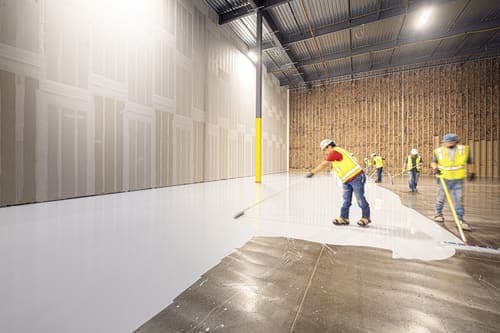
Commercial Concrete Floor Coatings
Coatings are what you put down when the floor has to do something the concrete cannot: resist chemicals, take a specific color, meet a slip requirement, or wipe clean in a food handling area, which in this valley is a common ask.
Epoxy is the workhorse, hard and chemically resistant. Urethane and polyaspartic topcoats go over it where UV exposure or abrasion would otherwise dull it, and polyaspartic cures fast enough to turn a floor around over a weekend. Where slip resistance matters, aggregate gets broadcast into the coat rather than added as an afterthought.
Everything depends on preparation and moisture. The slab gets mechanically profiled, not acid etched, and we test for vapour transmission before quoting. A coating over a slab with no vapour barrier under it will lift, and no product claim changes that.
We will tell you when a coating is the wrong answer and polishing is the right one, even though the coating is the bigger invoice.
Commercial Polished Concrete
Polished concrete is the slab you already have, ground and refined through progressively finer diamond grits until it takes a sheen, with a densifier worked in along the way to harden the surface.
It is genuinely different from a coating. There is nothing on top to peel, chip or delaminate, which is why it lasts in places where epoxy fails. Maintenance is sweeping and occasional burnishing rather than recoating. For a showroom, a retail floor, or a warehouse where forklift traffic destroys anything applied, it is usually the lowest lifetime cost by a distance.
The honest limits: it needs a slab worth polishing. Badly cracked, patched, or too-soft concrete will show every bit of that, and grinding exposes the aggregate, so what you get depends on what is in your slab. We test a small area first so you see the actual aggregate rather than a photograph of somebody else's.
Gloss level is a choice, and higher is not automatically better, because a high polish shows every scuff.
What the job involves
It starts with your schedule rather than ours. We walk the site, work out what has to stay open, and build the sequence backwards from that: which bays close, in what order, on which nights.
Then the ordinary work. Demolition and haul-off where we are replacing, subgrade prepared and compacted, vapour barrier where the building calls for one, steel tied and inspected. Pours are planned for volume and continuity, with the cold joints falling where we chose. Finishing to the flatness the drawing specifies, joints cut early enough to control the cracking, and a proper cure rather than letting a hot afternoon take the water out of the top.
A dock apron or an enclosure pad is a couple of days. A full floor replacement is staged over weeks, in sections, so you keep trading.
We give you the sequence in writing before we start, and we tell you when it slips.
What it costs
Straight answer first: commercial work prices on square footage, slab thickness and mix strength, reinforcement, and above all on when we are allowed to do it. Ready mix runs $100 to $200 a cubic yard, labor about $45 an hour, and night or weekend working carries a premium that is real rather than opportunistic.
The things that move a commercial number most are demolition and disposal of the existing floor, whether a pump is needed to reach, the flatness tolerance you are holding us to, and how many separate mobilisations the staging requires. Five small pours over five weekends costs meaningfully more than one continuous pour, and sometimes that is still the right trade for a business that cannot close.
Coatings and polishing price separately, on prep as much as on product.
Call us at (831) 539-2803 with your drawings or your square footage and we'll put a staged number together.
When commercial concrete is the wrong fix
Sometimes commercial concrete is the wrong fix, and I would rather say that before a saw ever touches your lot. If the slab is sound and has just dropped at a joint, ripping it out buys you demolition, hauling and days of blocked-off pavement, when commercial concrete leveling would raise it back and put trucks on it again the same week. Spalled edges and a couple of broken curbs are the same story: that is concrete repair, and a patch tied into solid material holds up fine.
And if this is your home rather than a warehouse, you do not need a commercial concrete company at all. A concrete driveway gets poured thinner, and if you want it to look like something, stamped concrete and other decorative concrete finishes are where that money belongs.
Why choose us for this
You've got a floor, an apron or a loading pad that needs doing, and the real problem isn't the commercial concrete, it's getting it done without losing days of trading.
So I'll tell you up front what we can pour over a weekend and what we can't, before you build a schedule around a guess. What's on my quote is what's on the invoice unless you change what you're asking for, and a change gets priced before anybody picks up a trowel. I won't shorten the cure to hit a reopening date either, because a slab put back to work early spalls the first time a loaded forklift turns on it.
The cheaper bids from other commercial concrete contractors usually get there by trimming cure time, saw cut layout, or hauling the old slab off your yard. Having me walk it and price it obligates you to nothing.
Frequently asked questions
Can you work nights or weekends so we stay open?
Yes, and for most commercial jobs that is how we plan it from the start. We stage the work in sections so you keep trading, and we give you the sequence in writing before anything gets broken out.
How thick does a commercial slab need to be?
It comes off the engineering rather than off a rule of thumb, because it depends on the loads. A floor taking pallet jacks and one taking loaded forklifts are different slabs, with different thickness, mix strength and reinforcement. If you have drawings we build to them; if you do not, we will tell you when you need them.
Polished, sealed or coated?
Sealing is maintenance and suits most warehouse floors. Polishing suits showrooms and heavy traffic areas and lasts longest because there is nothing on top to fail. Coating is for when you need chemical resistance, a specific color, or a slip rating. We will tell you which one your floor actually wants.
How soon can we drive on a new slab?
Light foot traffic in a day or so, vehicles after about a week, and full design strength at twenty-eight days. Heavy loaded equipment should wait for that twenty-eight days, and rushing it is the most common cause of an early failure.
Do you handle ADA ramps and truncated domes?
Yes, and the measurements are not negotiable, so we build to them and check them rather than eyeballing a slope. Getting a ramp wrong means doing it twice.
How do we get started?
Call me at (831) 539-2803 or send the drawings. We will walk the site and build the staging around your hours.
Contact Salinas Concrete Company now
Pick up the phone and call (831) 539-2803, and you reach the owner of the commercial concrete company that will actually be standing on your slab, not a call center in another state. Somebody is here nine to five through the week, and messages get returned.
Two things help before I come out: how much of your lot or floor has to stay open while we work, and whether anybody has ever cut or patched the existing slab. Access moves everything on commercial concrete work, whether a pump truck can swing in off the street or we're wheeling material past a loading dock at six in the morning.
Then I walk it, measure, and tell you what the job honestly needs. Footings, leveling, sealing, coatings, we take on the full run of commercial concrete services.