That lip at the end of the walkway, the one your mother trips over every single visit.
We're concrete flatwork contractors, and flat work is most of what we pour in Salinas: sidewalks, patios, walkway installations, garage pads and stamped concrete pool decks, from Boronda down through Spreckels. Somebody's always in a hurry with a slab. It looks sharp in September, then the fog sits on it every night through the wet months, the edges spall, and a year later you've got a trip hazard and a hose that pools in the wrong corner.
So four inches of crushed rock goes down and gets rolled tight before I order a yard of mud. Size moves what you pay, so does access, whether the truck can back to the pad or we're wheeling it through a side gate, and how much old concrete has to come out first.
Keep reading for how the pour actually goes, the stamped and overlay work, what it runs and the questions that come up most. Call me at (831) 539-2803 and I will come stand on it with you.
Concrete Deck Footings
Concrete deck footings get buried and forgotten, right up until the deck starts leaning toward the fence. The ground here is heavy clay that swells through the rainy months and shrinks tight again by the end of the dry stretch, so a deck sitting on shallow pads will walk on you. I dig to undisturbed soil, usually 18 to 24 inches, sized to the post load and belled at the bottom where the dirt is soft. Rebar goes in the hole. Post bases get set in the wet mix and lined up off a string, not tapped into place ten minutes later once the pour has started grabbing. Those bases hold the post about an inch clear of the concrete so the end grain isn't drinking standing water every wet season.
What changes the work, and the price with it, is hole depth, what the soil turns out to be once we're two feet down, how many piers the frame needs, and whether an auger or a truck can actually get into the yard or everything comes through a side gate by wheelbarrow. Any of the concrete contractors in Salinas worth calling will size the piers off the post load instead of digging the same hole everywhere, whether you're framing wood on top or setting a concrete deck over the piers.
Concrete Sidewalk
A concrete sidewalk is public property in the eyes of anybody who trips on it, and around here the usual culprit is a liquidambar root lifting one panel half an inch above its neighbor. Once that lip shows up, grinding it buys you a year, maybe two. We saw the bad panels out full depth, cut the roots back and set a barrier so the same tree doesn't repeat the trick, then pour four inches over compacted base with joints tooled every four to five feet so the cracks land where we chose, not where they feel like it. Cross slope stays under two percent so a wheelchair isn't fighting the walk.
Foot traffic in a day or two, full strength in about a week.
Right-of-way work needs a city permit, and as concrete contractors in Salinas we pull it before the saw starts.
Concrete Slab With Rebar
Rebar is the part nobody sees and everybody argues about. On our slabs it's usually #4 bar on an 18 inch grid, tied at the intersections, lapped properly where bars meet, and sitting on chairs or dobies so the steel ends up in the middle of the pour instead of napping on the dirt. That last bit is where slabs go wrong. Hooking the bar up with a rake halfway through a pour is the concrete version of adding flour after the cake is baked, and the crack shows up two winters later when our clay soil swells with the rain and shrinks again by August.
Thickness follows the load. Five or six inches with heavier steel if a work truck or a trailer lives on it, four for a patio.
Ask us how we're detailing your slab before we pour. Most concrete contractors in Salinas will tell you the mix; fewer will tell you the grid, and the grid is what holds your concrete flatwork together.
Stamped Concrete Walkway
A stamped walkway lives or dies inside a short window. We pour, float, wait, then stamp when the surface holds a thumbprint but still takes the mat. Miss it by twenty minutes and the pattern goes shallow, the joint lines look printed on rather than pressed in, and there's no fixing it in the morning. So we bring enough hands to stamp the whole run in one pass, and we watch the afternoon wind coming up the valley, because it stiffens a slab faster than any forecast admits.
Slate concrete stamp is what most people pick here. Brick concrete stamp suits anything near an older Old Town frontage. Integral color goes in the mix, release powder on top, then a wash and a sealer once it's cured.
It's the fussiest flatwork concrete contractors in Salinas get asked for, and reseal it every two or three years or the color chalks out.
Stamp Overlay Concrete
If your patio looks tired but the slab under it is still sound, you don't have to break it out. A stamp overlay concrete job lays about three eighths of an inch of polymer-modified mix over what's already there, stamped with a slate concrete stamp or a brick concrete stamp, then sealed.
The prep is the whole job. We grind or shot blast the surface open, chase the cracks, and roll a bond coat. Skip that and the overlay peels off in sheets. Our morning marine layer also keeps the mix from setting on schedule, so we time the stamp, not the clock.
One honest limit: an overlay doesn't fix movement. If a crack is still opening, it telegraphs through the pattern, and that's when concrete contractors in Salinas should tell you to replace the flatwork instead. Figure two to three days, and stay off it a full day.
Concrete Walkway Installation
A front walk takes more foot traffic per square foot than any other slab on your property, and it's the one your neighbors actually look at. So concrete walkway installation starts underneath: four inches of compacted base, forms set with real fall away from the house so winter rain runs to the lawn instead of ponding at your threshold. Four inches of concrete, thicker where a truck tire might clip the edge. Control joints every four to five feet, cut the same day, because concrete cracks and joints decide where.
Most concrete contractors in Salinas can pour a straight path. The trouble comes from roots. Those big liquidambars along the older streets will lift a walk in a few seasons if nobody cuts the offending root and adds thickness over it.
Walkable in a day or so. Full strength takes about a month, like all our concrete flatwork.
Concrete Restoration
Restoration is the middle ground between living with tired concrete and tearing it out, and on a sound slab it is a fraction of the cost of replacement.
Overlays are the main tool: a cementitious layer bonded over the existing surface, anywhere from a skim coat that evens out a worn patio to a stampable overlay that gives an old slab a pattern and a color it never had. Micro-toppings do the same at a thinner build for interior floors.
The rule that decides whether it works is simple. Restoration fixes surfaces, not structures. If the slab is sound and just looks bad, an overlay is money well spent and will last years. If it is cracked with movement, rocking underfoot, or sinking at one corner, an overlay is a fresh surface on a failing slab and it will mirror every crack within a couple of seasons.
We test bond and check the slab before quoting, because I would rather tell you no than come back.
What the job involves
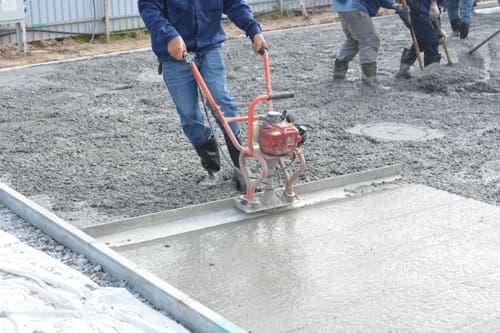
Every pour starts with a shovel, not a mixer. We strip what's there, cut the grade, and compact the base until the plate compactor stops sinking, because that layer carries the load, not the concrete. It's the least glamorous day of the job, and it's the one that decides whether you're calling concrete contractors in Salinas again in five years. Then forms, mesh or rebar, and a pour timed around the weather. Foggy mornings set slow; a dry afternoon wind can crust the surface before we've finished floating it. Control joints get cut inside the first day, roughly every ten feet, so the slab cracks where we put the line instead of wherever it feels like. Thickness, truck access and how much demo comes first are what move a concrete flatwork quote. Most jobs are two or three days on site, and you stay off it about a week.
What it costs
Here's the honest arithmetic. Ready mix runs $100 to $200 a cubic yard delivered, and labor lands around $45 an hour, or roughly $2.50 a square foot once the crew is placing and finishing. Even stripping forms, cleaning up and stacking adds $0.30 to $0.60 a foot, which is why a plain gray concrete sidewalk and a stamped concrete walkway never quote the same. Stamped concrete cost climbs with the pattern, the release color and the sealer, and a slate concrete stamp takes more hand tooling than a brick concrete stamp on the same square footage.
What really moves your number is what's underneath. Soft ground off Blanco Road, an old slab that needs breaking out, thickened edges for a concrete deck.
Call me at (831) 539-2803 and I'll measure it and give you a real figure instead of a guess.
When concrete flatwork is the wrong fix
Sometimes concrete flatwork is the wrong fix, and I would rather tell you that standing on the thing than pour something destined to fail. If one corner of a patio has dropped an inch or so and the surface itself is sound, lifting it back is cheaper than replacement and you keep the concrete patio you already have. If it is just tired looking, dull and stained but flat and solid, a stamp overlay does more for it than a tear out. If cracks are marching in from the house because the concrete foundation is moving, anything new will split the same way inside a year, so the structure gets sorted first. Where the ground underneath has turned soft, concrete removal and a rebuilt base come before a single truck shows up. And concrete steps are formed and tied as their own job, not poured flat and hoped over.
Why choose us for this
You've got a walkway that's lifted at one joint and a concrete slab out back going chalky, and you've stepped over both so long you stopped seeing them. What you want is one call, one crew, and then years of not thinking about your concrete flatwork again.
So, a few facts about how I work. The number I hand you is the number, unless you ask me to widen the pour or add a section. Your job gets finished before another one starts. And I won't pour over soft ground to make a schedule work, because that's how a slab ends up needing jacking three years later.
I'm not the low bid among concrete sidewalk contractors around here. Base prep and control joints cut where they belong take hours. Size, access, thickness and the condition of what's there now move the price. The estimate is free, and asking for one ties you to nothing.
Frequently asked questions
How long before I can walk on new concrete flatwork?
You can walk on them carefully after about twenty-four hours, put a car on it at seven days, and it hits full strength around twenty-eight days. Curing matters more than most people expect. Let the top dry out too fast in a windy afternoon and you get crazing, that fine map of hairlines across the surface, so we keep the slab damp or sealed through the first few days and let it harden slow.
What is the difference between a stamp overlay and new stamped concrete?
A stamp overlay concrete job lays a thin stamped topping over a pad that is still structurally sound. If the existing one is cracked clean through or lifting at a joint, the overlay just copies that fault and you are looking at it again by next year. Then it is tear out and pour fresh, with the stamped concrete walkway pattern pressed in while the mix is still plastic.
How do I pick reliable concrete slab contractors?
Ask to see work that is three or four years old, not something poured last week. Sprinklers, sun and delivery trucks have had a go at it by then, and the joints and corners tell you the truth. We are glad to point you at ours. Ask what goes inside the pour, too: a concrete slab with rebar tied up on chairs sits in the middle of the thickness where it does something, while mesh thrown down and walked flat sits on the dirt doing nothing.
Contact Salinas Concrete Company now
Contact our Salinas concrete company now if the concrete flatwork out front has gotten to the point where you plan your steps around it. Call me at (831) 539-2803 and we'll pick a morning to walk it together. What I want to look at is the ground, where the water goes when it rains, and how close the mixer can get, because a pour we chute straight off the truck runs very differently from one we're wheeling in by barrow past a side gate. Access, size and how far the damage has gone are what shift the number.
Give me the whole list while I'm standing there: concrete walkway installation off the driveway, concrete restoration on the patio, stamped concrete pool decks, a stamp overlay concrete finish. Phone lines are covered nine to five, weekdays, and messages get returned.